
ADVANCED INTERLAYER SOLUTIONS Our commitment to a sustainable future
We are conscious that a certain amount of greenhouse gases
results from the industry we work in.
We as a corporation accept responsibility for this and work
to increase our productivity across the board.
We are committed to developing new fields of business
using pioneering technology that improves the environment and
enhances the quality of life throughout the world.
Growth and responsibility towards people and the environment are fundamental principles of all Kuraray employees’ actions worldwide.
- Environmental protection and safety are top priorities in our company.
- We strive for a lasting improvement in environmental protection.
- We develop products and technologies that help improve the environment.
- We will always conduct business in a free, fair and transparent manner.

Introducing Trosifol® R3: Sustainable Glazing We are excited to unveil Trosifol® R3, our most sustainable interlayer yet, designed to meet the growing demand for eco-friendly solutions in architecture and automotive industries.


A life cycle assessment is a method of quantifying a product’s environmental impact based on an array of materials, products, processes or activities – from raw-material extraction to the product’s final disposal.
Since our PVBs are used in numerous applications, a cradle-to-gate (raw material extraction to the factory gate) analysis was performed. This includes all production steps, from the production of raw materials and chemical precursors to energy production and consumption, transport and processing.
Global Warming Potential (GWP) measures the total greenhouse gas emissions associated with the production processes, expressed in CO₂ equivalents, and represents the product’s contribution to climate change during its lifecycle up to the factory gate.

We’ve created tables that give users an easy reference to compare the relative global warming potential (GWP) of our materials.

We’ve created tables that give users an easy reference to compare the relative global warming potential (GWP) of our materials.

We’ve created tables that give users an easy reference to compare the relative global warming potential (GWP) of our materials.
Downloads
Environmental Product Declaration as per ISO 14025 and EN 15804+A2 PVB film
Environmental Product Declaration as per ISO 14025 and EN 15804+A2 Ionoplast film (SentryGlas®) interlayer
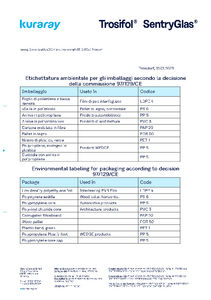
AIS marking of environmental packaging
